Email:
info@isothermalengineering.co.ke
Phone:
+254 720 686 454
Location:
KCB Building, Enterprise Road, Industrial Area
Nairobi, Kenya
Email:
info@isothermalengineering.co.ke
Phone:
+254 720 686 454
Location:
KCB Building, Enterprise Road, Industrial Area
Nairobi, Kenya

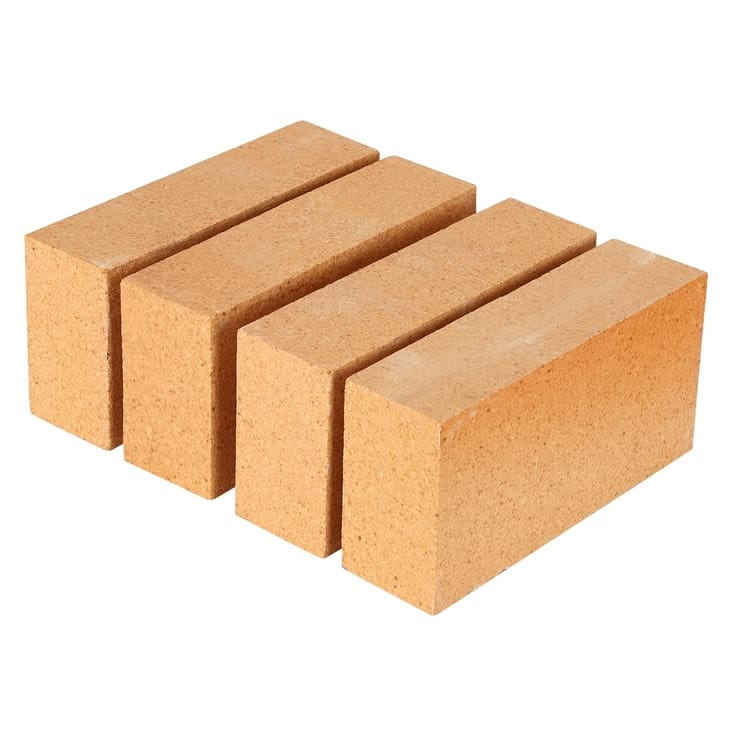
A 40% alumina firebrick is a refractory brick made from fireclay (kaolinite-based clay) with an alumina (Al₂O₃) content of roughly 38–42%. It falls into the “High-Duty” fireclay refractory classification (per ASTM C27 standards) . It’s one of the most widely used refractory bricks in general industrial furnace and kiln construction due to its balance of cost, availability, and thermal performance.
| Component | Typical % |
|---|---|
| Alumina (Al₂O₃) | 38–42% |
| Silica (SiO₂) | 50–55% |
| Iron Oxide (Fe₂O₃) | 1.5–2.5% |
| Titania (TiO₂) | 1–2% |
| Alkalis (Na₂O + K₂O) | <2% |
| Property | Typical Value | Notes |
|---|---|---|
| Alumina Content | 38–42% | Defines classification |
| Bulk Density | 2.0–2.2 g/cm³ | Affects heat storage/insulation |
| Apparent Porosity | 18–22% | Lower porosity = better strength & slag resistance |
| Cold Crushing Strength (CCS) | 25–45 MPa | Load-bearing capacity at room temp |
| Refractoriness (PCE – Pyrometric Cone Equivalent) | Cone 31–33 (~1690–1730°C) | Softening point under no load |
| Refractoriness Under Load (RUL, Ta) | ~1350–1400°C | Softening onset under load |
| Maximum Service Temperature | 1350–1400°C | Practical operating limit |
| Thermal Conductivity | 0.8–1.0 W/m·K (at 1000°C) | Moderate insulating value |
| Reheat Linear Change (Permanent Linear Change) | ≤0.5% at 1350°C | Dimensional stability indicator |
| Coefficient of Thermal Expansion | ~5.5 x 10⁻⁶/°C | Relevant for thermal shock design |
| Modulus of Rupture | 4–7 MPa | Resistance to bending/breaking |
| Thermal Shock Resistance | Good | Withstands rapid heating/cooling cycles |
Used in the medium-temperature zones of reheating furnaces (heating steel billets/slabs before rolling) and annealing furnaces (relieving internal stresses in metals). These zones typically operate below 1400°C, making 40% alumina brick a cost-effective choice compared to higher-alumina grades needed only in the hottest zones.
Firebricks form the primary lining material in brick kilns (firing clay bricks for construction), lime kilns (calcining limestone into quicklime), and ceramic kilns (pottery, tile, sanitaryware manufacturing). 40% alumina firebrick provides a durable, heat-retentive lining at manageable cost — especially important for small-to-medium brick and ceramic manufacturers common across East Africa.
Coal-fired and biomass boilers, common in sugar factories, tea/coffee processing, and breweries, use firebrick to line the combustion chamber and flue passages, protecting the boiler shell and maintaining combustion efficiency. Combustion zones typically don’t exceed the brick’s 1350–1400°C service limit.
Municipal and industrial waste incinerators require refractory linings that handle fluctuating temperatures and some chemical exposure. 40% alumina firebrick is commonly used in secondary combustion chambers and flue sections where temperatures are moderate.
In blast furnace hot-blast stoves, 40% alumina firebrick is used in the outer, cooler zones — not the extreme hot-face areas, which require 70%+ alumina or silica brick — offering a cost-effective solution for less thermally demanding sections.
Coke oven batteries use firebrick extensively in battery wall construction. 40% alumina brick is typically used in structural and lower-temperature sections, working alongside silica brick used in the hottest coking chamber walls.
A popular choice for residential and commercial fireplace construction and wood-fired pizza ovens, thanks to its ability to withstand direct flame contact, retain heat for even cooking, and its manageable cost. This is a growing segment as hospitality businesses across East Africa increasingly build wood-fired pizza ovens.
Cupola furnaces, used in foundries to melt iron for casting, use firebrick lining in their lower-temperature zones (upper shaft and charging areas). 40% alumina brick offers small-to-mid-scale foundries across East Africa an affordable lining option for these sections.
Industrial chimneys and flue systems attached to furnaces, kilns, and boilers use firebrick to protect the outer structure from heat and prevent thermal degradation over time.
Isothermal Mechanical Engineering supplies 40% alumina firebricks to industries across Kenya, Uganda, Tanzania, Rwanda, and Ethiopia. Below are the key industries we serve in the region:
| Industry | Countries with Major Demand | Typical Grade Needed |
|---|---|---|
| Cement Manufacturing | Kenya, Tanzania, Uganda, Ethiopia | 40–70% alumina (kiln zones) |
| Sugar Processing (boilers) | Kenya, Uganda, Tanzania | 40% alumina |
| Tea/Coffee Drying (furnaces & boilers) | Kenya, Rwanda, Uganda, Burundi | 40% alumina |
| Brick & Ceramics Manufacturing | Uganda, Rwanda, Tanzania | 40% alumina |
| Foundries (informal & industrial) | Kenya, Tanzania | 40% alumina |
| Lime Production | Tanzania, Ethiopia | 40–60% alumina |
| Brewing Industry (boilers) | Kenya, Tanzania, Uganda | 40% alumina |
| Steel & Metal Smelting | Kenya, Ethiopia, Tanzania | 60–70% alumina |
| Glass Manufacturing | Kenya, Uganda | 70% alumina |
What is 40% alumina firebrick used for?It is used in medium-temperature furnace linings, kilns, boilers, incinerators, fireplaces, pizza ovens, foundry cupolas, and chimney linings — anywhere service temperatures stay below approximately 1400°C.
What is the maximum temperature of 40% alumina firebrick?Typically 1350–1400°C, depending on load conditions and duration of exposure.
What is the difference between 40% and 70% alumina firebrick?70% alumina firebrick offers higher maximum service temperature (up to ~1600°C), greater crushing strength, and better slag/chemical resistance, but at a higher cost. 40% alumina brick is more cost-effective and suited to medium-temperature applications.
What is the standard size of 40% alumina firebrick?The most common standard sizes are 230 x 114 x 65 mm and 230 x 115 x 75 mm. Custom sizes are available on request for specific furnace or kiln designs.
Do you supply firebricks across East Africa?Yes — Isothermal Mechanical Engineering supplies 40% alumina firebricks to Kenya, Uganda, Tanzania, Rwanda, and Ethiopia, serving cement, sugar, tea/coffee, ceramics, foundry, and brewing industries.
Need 40% Alumina Firebricks for Your Furnace, Kiln, or Boiler?
Isothermal Mechanical Engineering supplies bulk and custom orders across Kenya, Uganda, Tanzania, Rwanda, and Ethiopia. Contact us for a quote and technical guidance on selecting the right refractory grade for your application.